

In the realm of electric vehicle technology, hub motors have emerged as a revolutionary solution, offering numerous advantages such as compact design, high efficiency, and direct drive capabilities. As a proud supplier of the ZDL - 03 Hub Motor, I am excited to delve into the concept of back - electromotive force (EMF) and its significance in the operation of our motor.
Understanding Back - Electromotive Force (EMF)
Back - electromotive force, often abbreviated as back - EMF, is a fundamental concept in the field of electrical engineering, especially when dealing with electric motors. According to Faraday's law of electromagnetic induction, when a conductor moves through a magnetic field or when the magnetic field around a conductor changes, an electromotive force (EMF) is induced in the conductor. In an electric motor, this induced EMF opposes the applied voltage, hence the term "back - EMF."
Mathematically, the back - EMF ($E_b$) can be expressed using the following formula:
[E_b = k\phi\omega]
where $k$ is a constant related to the motor's construction, $\phi$ is the magnetic flux, and $\omega$ is the angular velocity of the motor's rotor.
Back - EMF in the ZDL - 03 Hub Motor
The ZDL - 03 Hub Motor is a high - performance motor designed for electric motorcycles and other light electric vehicles. In this motor, the back - EMF plays a crucial role in its operation and performance.
Impact on Motor Efficiency
One of the key benefits of the back - EMF in the ZDL - 03 Hub Motor is its contribution to energy efficiency. As the motor rotates, the back - EMF opposes the applied voltage. This opposition reduces the net voltage across the motor's windings, which in turn reduces the current flowing through the motor. According to Ohm's law ($V = IR$), a lower current means less power dissipation in the form of heat ($P = I^{2}R$). As a result, the motor can convert a larger proportion of the electrical energy into mechanical energy, leading to higher efficiency.
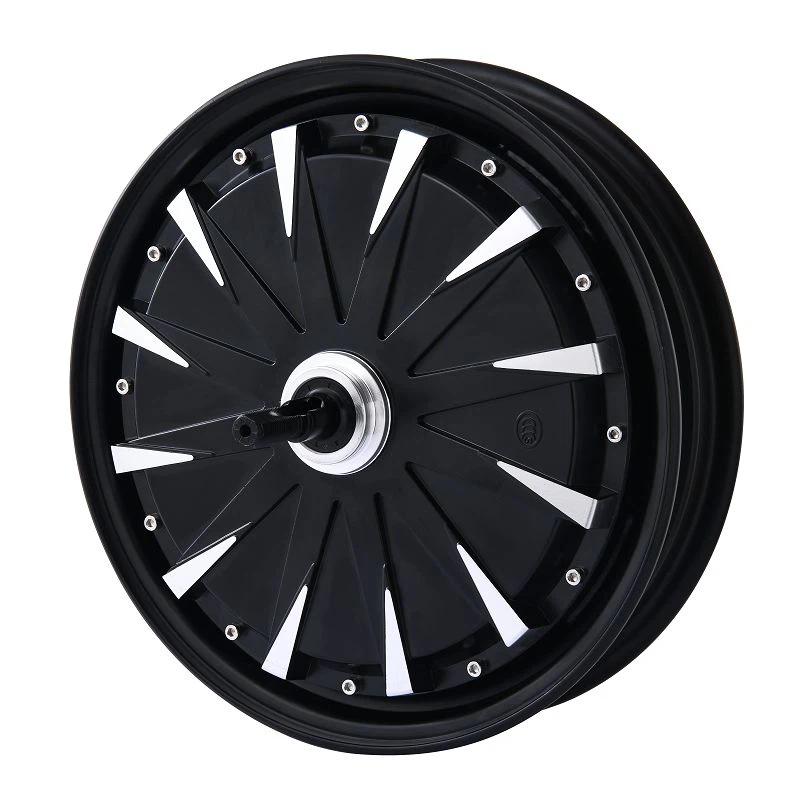
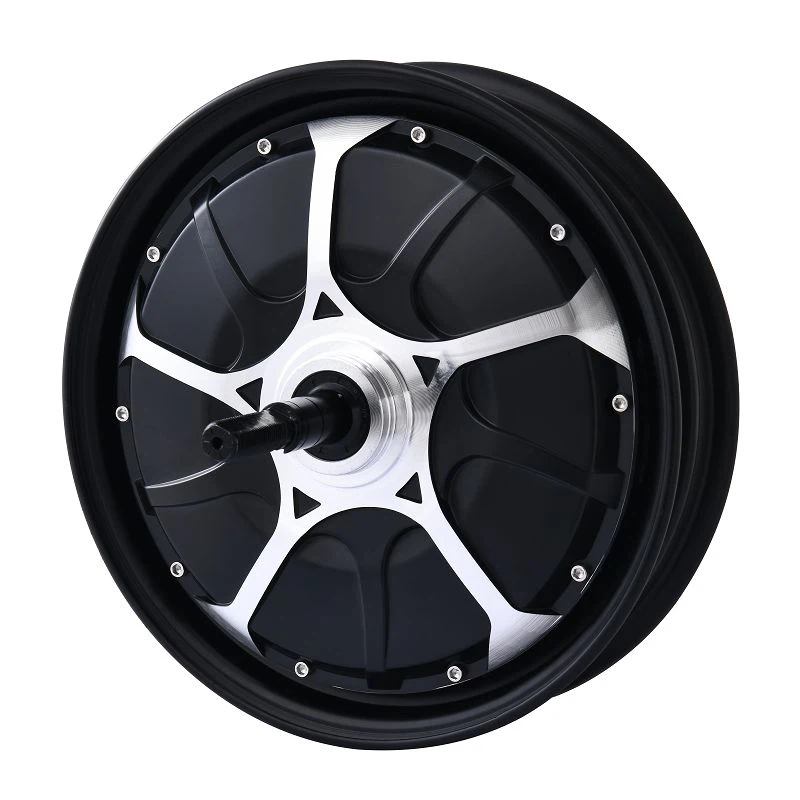
For example, when the ZDL - 03 Hub Motor is running at a high speed, the back - EMF increases proportionally with the angular velocity. This increased back - EMF reduces the current draw from the power source, allowing the motor to operate more efficiently. This is particularly important for electric vehicles, as it can extend the vehicle's range on a single charge.
Speed Regulation
The back - EMF also serves as a natural speed regulator for the ZDL - 03 Hub Motor. When the motor is loaded, its speed tends to decrease. As the speed decreases, the back - EMF also decreases according to the formula $E_b = k\phi\omega$. With a lower back - EMF, the net voltage across the motor's windings increases, causing an increase in the current. The increased current provides more torque to the motor, which helps to maintain the motor's speed under load.
Conversely, when the load on the motor is reduced, the motor's speed increases. The increased speed leads to an increase in the back - EMF, which reduces the net voltage and current. This self - regulating mechanism ensures that the ZDL - 03 Hub Motor can maintain a relatively stable speed under varying load conditions.
Comparing with Other Hub Motors in Our Series
As a supplier, we also offer other hub motors in our product line, such as the ZDL - 01 Hub Motor, ZDL - 02 Hub Motor, and ZDL - 04 Hub Motor. Each motor has its own unique characteristics and back - EMF behavior.
The ZDL - 01 Hub Motor is designed for applications that require lower power and speed. Compared to the ZDL - 03 Hub Motor, it has a lower back - EMF due to its lower magnetic flux and angular velocity capabilities. This makes it more suitable for small electric scooters and low - speed electric vehicles.
The ZDL - 02 Hub Motor is a mid - range motor with a balance between power and efficiency. Its back - EMF characteristics are optimized for medium - speed electric motorcycles. It offers a good combination of speed regulation and energy efficiency, similar to the ZDL - 03 Hub Motor but with slightly different performance parameters.
The ZDL - 04 Hub Motor is a high - power motor designed for high - speed electric motorcycles. It has a higher back - EMF compared to the ZDL - 03 Hub Motor, which allows it to operate at higher speeds while maintaining good efficiency. However, this also means that it requires a more powerful power source to overcome the higher back - EMF.
Measuring and Controlling Back - EMF in the ZDL - 03 Hub Motor
Measuring the back - EMF in the ZDL - 03 Hub Motor is an important aspect of motor control and performance optimization. One common method is to measure the terminal voltage of the motor and subtract the voltage drop across the motor's internal resistance ($IR$) from the applied voltage. The remaining voltage is approximately equal to the back - EMF.
In terms of control, the back - EMF can be used to implement various control strategies. For example, in a closed - loop speed control system, the back - EMF can be used as a feedback signal. By comparing the measured back - EMF with a reference value, the controller can adjust the applied voltage to the motor to maintain the desired speed.
Conclusion
The back - electromotive force is a critical factor in the operation and performance of the ZDL - 03 Hub Motor. It contributes to the motor's energy efficiency, speed regulation, and overall performance. As a supplier, we have optimized the design of the ZDL - 03 Hub Motor to take full advantage of the back - EMF phenomenon.
If you are interested in our ZDL - 03 Hub Motor or any other products in our hub motor series, we invite you to contact us for procurement and further discussions. Our team of experts is ready to provide you with detailed product information and technical support to meet your specific requirements.
References
- Fitzgerald, A. E., Kingsley, C., & Umans, S. D. (2003). Electric Machinery. McGraw - Hill.
- Chapman, S. J. (2012). Electric Machinery Fundamentals. McGraw - Hill.